


There's been a lot of progress to fix California's housing crisis, because the State Legislature has finally decided to fix things. Credit where credit is due. There's going to be two parts to this post. The first part will be a summary of what the Legislature has done to fix things; the second will be what the legislature needs to get done. You'll note that there's not a whole lot of local reforms in here. Some city councils have acted in good faith to do their part, like Sacramento, Oakland and Berkeley. But most, like LA, SF and San Jose, have fought these reforms tooth and nail.
Let's talk about what the Legislature has fixed so far.
There are a lot of major reforms on this list. So far, they've:
- Reformed the minimum parking law. In most places it used to be legally required to absurd amounts of parking for commercial and residential buildings. This is how you get crazy stuff like the Beverly Center in West LA, which is half parking by square footage, or my old place in Koreatown, which was a 1000-square-foot apartment with 800 square feet of parking. Bill AB2097 reformed the law so that no parking is required close to public transportation. (This was a pet project of Glendale Assemblymember Friedman, who is now in Congress.)
- Re-legalized small-scale redevelopment. In 2016, the State legalized ADUs (aka casitas/in-law units/granny flats) statewide. It's been a massive success at building housing on the cheap, and an entire cottage industry of ADU builders has grown up. The City of LA even got in on the game and released a standard ADU pattern that can be used by anyone. The follow-up bills to that have expanded the ADU law to cover other types of small-scale buildings that any general contractor can build. SB9 legalized duplexes statewide. SB684 and SB1123 made it legal to build small-lot townhouses in apartment zones and vacant single-family lots. (They really should allow townhouses in all single-family lots, but I digress.)
- Rezoned the whole state to allow apartments near transit. The big rezoning bill, SB79, passed this year after seven years of brutal political fights. (Notably, its predecessors, SB827 and SB50, fell short in 2018 and 2020 Newsom's desk.) SB79 legalizes mid-rise apartments near high-capacity transit, like Metro lines and frequent Metrolink. This is how walkable cities like SF, DC, Boston and Philadelphia were built in the past. It marks a sort of back-to-the-future.
- CEQA reform. For decades, the California Environmental Quality Act was used by nosy neighbors in bad faith to stop new housing and transit from being built. No longer. In 2020, the Legislature temporarily exempted transit, pedestrian and bike projects from CEQA under SB288, and made the exemption permanent in 2025. New housing was exempted from CEQA this year, through Bill AB130/SB131.
Now, all of these laws seem like kind of scattershot, because there's no silver bullet to solve the housing crisis. But collectively, it's a huge deal. It's a laundry list of the big stuff that was wrong with California housing policy.
What comes next: sweating the small stuff
Now that the big stuff has been dealt with, it's time for the legislature to start sweating the details. There's a whole laundry list of things to fix.
-
Making it possible to build condos again. New condo construction has almost completely stalled in California in the last 15 years because of the unintended consequences of California's condo defect law. Unlike other states, California allows condo owners to sue for defective construction up to 10 years after construction is complete. (This is much longer than rental buildings, which have a four-year statute of limitations.) Making matters worse, going to court is the only available method of redress. This system has to be changed.
Other places, like New Jersey and Canada, have a standardized defect resolution program which is much cheaper than suing in court. Another alternative is to simply shorten the statute of limitations so that the warranty period doesn't overlap with normal wear and tear. -
Building code reform. California is really behind the curve when it comes to its building codes. There's two big changes that have to happen.
Number 1 is to reform the stair code. Yes, really. The vast majority of US apartment buildings are legally required to have two sets of staircases, and California is no exception. This two stair requirement dates back to the bad old days, when buildings were built with worse materials and were more likely to catch fire, but it's now obsolete thanks to modern building materials and firefighting advances. Single-stair apartment buildings just as safe in a fire as double-stair buildings. (Single-stair buildings have been legal in New York City and Seattle for decades, which allows us to compare apples to apples.)
The double stair requirement is a huge drawback in three ways. First, two sets of stairs usually makes it geometrically impossible to build an apartment building on a typical 50' x 125' lot. Developers have to buy adjoining lots to build a code-compliant apartment building, which raises costs. (The most common type of LA apartment - the postwar dingbat - was almost always built on a single lot.)
The postwar dingbat, a classic single lot apartment building. Illegal to build nowadays.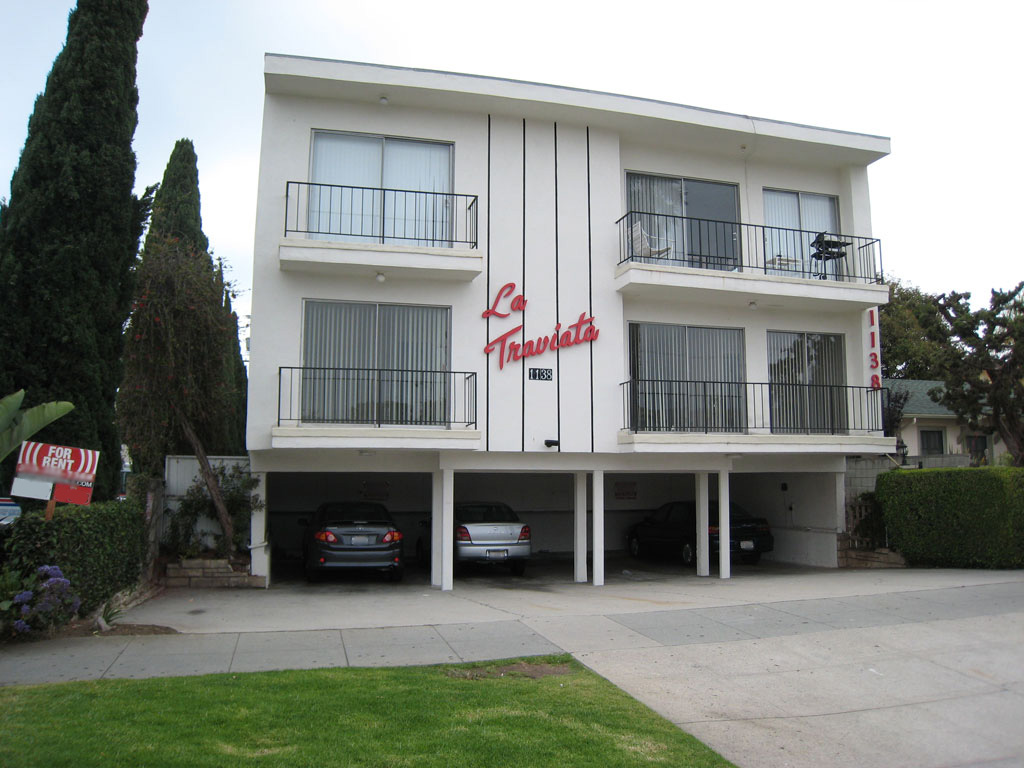
Second, two stair buildings make for worse apartments. It's common for double-stair apartments to only get sunlight from one direction because all units have to face the hallway. Single-stair buildings don't have this problem because apartments wrap around the staircase and elevator, giving sunlight from multiple directions. Third, single-stair buildings make it easier to build family-sized 3-4 bedroom apartments - something that's completely normal in Europe but extremely rare in LA. Single-stair apartment buildings give better light and air than double-stair buildings. Image credit: Alfred Twu.
The other big fix is to make the building code uniform statewide. While there is a state building code, every city customizes it. These local modifications make it more complicated for developers to cross municipal lines, and they make construction more expensive. In France, by comparison, there is one national building code, which makes it possible to do things at industrial scale. For example, it's common in France to have factory-built bathroom modules, which are prefabricated and plopped in wholesale in during the construction process, instead of each bathroom being built on-site from scratch as in the US.
The French manufacture bathrooms at scale.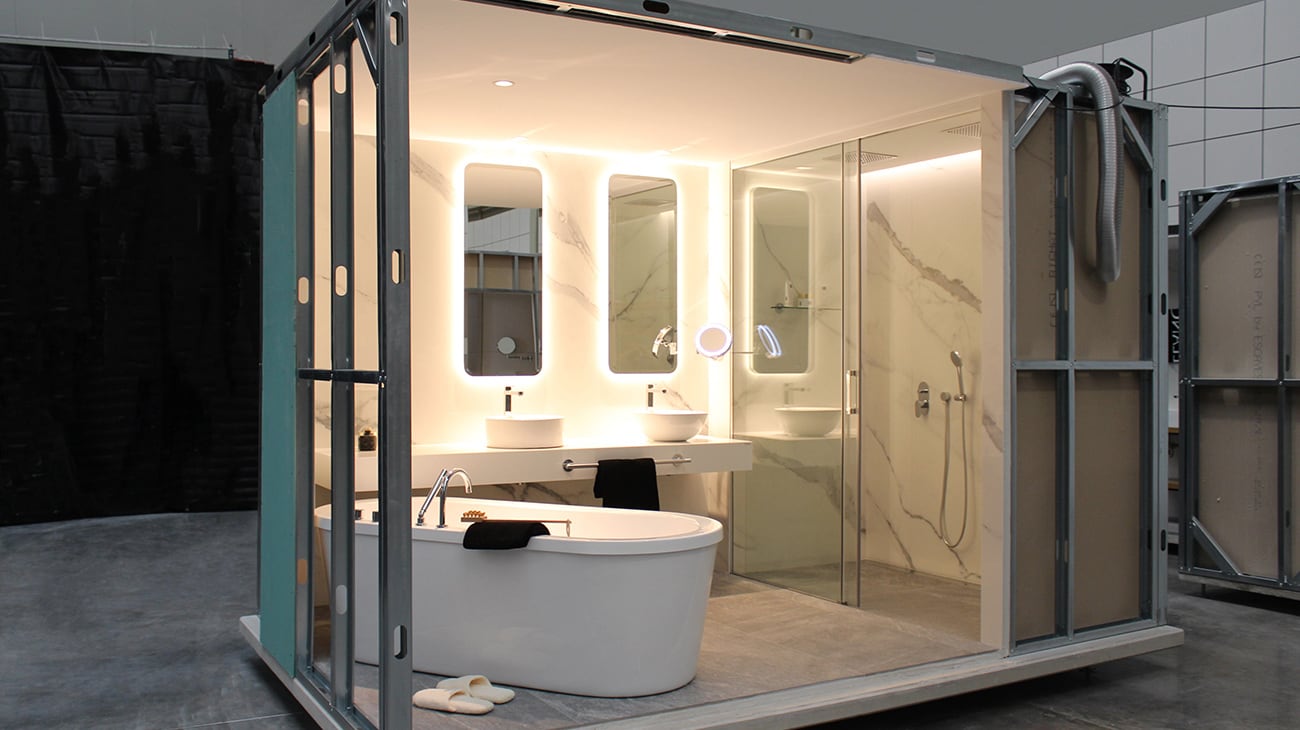
-
Impact fees. It's common for cities to charge fees to build new apartment buildings. But it's even more common for city fees to be used as a weapon against apartment developers. Take Palo Alto in NorCal, for example. There, the fees are so high that they effectively ban new apartment construction downtown. It's effectively a 15% tax on new construction. (If someone has a study from LA that analyzes this dynamic, I'd love to see it.)

- Uniform anti-displacement standards. We all agree that it's bad when people get displaced from their neighborhoods by gentrification. But the current law is a patchwork of different standards, and it's genuinely hard to determine what's kosher, even for lawyers. For a simple example: SB684 (the townhouse law) bans the demolition of units occupied by tenants in the last five years. The standard under SB79 (the homes-near-transit law) is seven years. And that's just the beginning of it. There really needs to be a state-level fix for this, one uniform standard. Colleagues who work in Sacramento are aware of this problem; they're going to try to put a uniform standard soon.
-
Affordable housing reform. A lot of cities require a percentage of new units to be rent-controlled. Pasadena requires 20%; Whittier requires 15%; Beverly Hills requires 10%; unincorporated LA County ranges between 10 and 20%. (Unless you're in the Antelope Valley or Santa Clarita.) It sounds like a good idea to require a percentage of new units to be affordable. But the money for those below-market units have to come from somewhere, and the money ain't coming from the gov.
Some developers deal with this by building ultra-luxury units, which turn enough of a profit that they can afford the rent-controlled units. Some can finagle it so there's a way to square the circle. But a lot of them see these requirements and say "lol nope, I'm out." NIMBY city councils know this dynamic very well. You'll often see them require high affordable housing percentages in bad faith, knowing that 20 percent of zero is zero.
There's a few different ways to fix this. The obvious one is to fund the mandatory affordable units directly, like Portland does. Another way is to replace the affordability mandate with an expanded density bonus. That is, if developers build X units of unprofitable affordable housing, they can build an extra Y units of profitable market-rate housing, like what LA City already does with the Transit Oriented Communities program. A third way is simply to make it unnecessary, by building so much housing that it doesn't matter whether a unit is rent-controlled or not. (That's what they did in Austin.) Hey, a guy can dream, right? -
Proposition 13. Last but not least, there's Proposition 13. For those who don't know what it does, Proposition 13 is the law that got us into this mess in the first place: property tax is based on the price the owner paid, not what it's actually worth. Identical properties can have wildly different valuations because of this. Just to give a personal example, my brother used to live in a building with three identical units in it. His landlady bought it during the Great Recession, and paid $5200 a year in tax. The downstairs neighbor bought in '07 during the real estate boom, and pays $9100 a year in tax. The upstairs neighbor bought in 2020 and he pays $11000 a year in tax. Aside from being on different floors, they're exactly identical units.
Worse, Proposition 13 also applies to commercial property, industrial property, and rental real estate, so landowners never have to sell. To give an example of what this looks like, check out this empty lot in Inglewood. It's currently valued at $402,000 under Prop. 13. The lot has been vacant for over a decade. The owner has been trying to flip it for a decade, putting it up for sale no less than four times. And because the property taxes are artificially low, there's no incentive for the owner to sell. It's legitimately the third rail of California politics. An attempt in 2020 to abolish Prop. 13 for commercial, industrial and agricultural property narrowly failed. I fully expect more reform attempts as the housing crisis gets worse, but I don't think it'll happen while Gavin Newsom is in office.
So, What's the TL;DR, then?
There's been honest-to-god progress on the housing front, and thankfully the big stuff is done. Now it comes time to do the hard work of getting the details right. But it's not going to be easy. NIMBYism has been a dominant force in California politics for half a century. We're winning - but the long war continues.